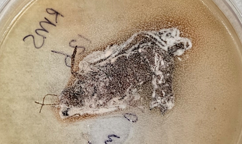
Streptomyces and insects engage in complex interactions shaped by millions of years of evolution. While many beneficial relationships are well-recognized, it remains unknown whether Streptomyces produce virulence factors targeting insects specifically. Here, through bioinformatic analysis, we identified diphtheria toxin (DT) homologues, which we named Streptomyces antiquus insecticidal proteins (SAIP), within a monophyletic lineage of Streptomyces that emerged more than 100 million years ago. SAIP is cytotoxic to insect cells and lethal to Drosophila melanogaster, suppressing neuronal activity and immune responses in vivo. Structural and functional studies validated that SAIP is homologous to DT and acts by ADP ribosylation of eukaryotic elongation factor 2. CRISPR-Cas9 screening identified the insect protein Flower as the SAIP receptor across a range of insects. Toxigenic Streptomyces can consume dead insects and produce bioactive secondary metabolites while growing on insect carcasses. These findings establish an insecticidal toxin in Streptomyces and demonstrate that Streptomyces have evolved highly specific virulence factors against insects.